
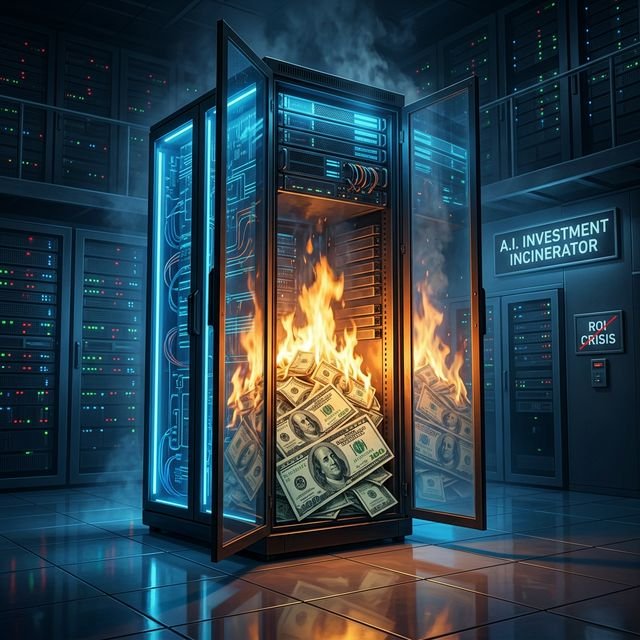
Everyone on Wall Street is shouting that Artificial Intelligence will unilaterally revolutionize the world and construct a utopian economy. Yes, the world is undoubtedly changing at a breakneck speed. However, they conveniently omit one terrifying caveat: the bank accounts of Big Tech shareholders are quietly plummeting from comfortable profits into an unrecoverable abyss of capital expenditure.
Welcome to 2026. Right now, we are witnessing the most colossal, unprecedented “Capital Incinerator” in the history of human economics. Generative AI infrastructure maintenance costs have skyrocketed exponentially, yet actual enterprise customers are furiously zipping up their wallets. Today, we slice through the sugar-coated corporate press releases and expose the brutal, unspoken truth that the mainstream media refuses to discuss: The 2026 AI ROI (Return on Investment) Crisis.
1. The 1-Winner Game: Nvidia’s Private Banquet
During the historic California Gold Rush, the men who actually struck it rich were not the desperate miners risking their lives. It was the monopolistic merchants selling them the pickaxes and shovels. Today’s generative AI landscape is a flawless recreation of this exact economic paradigm. Right now, the only entity actually printing cold, hard cash is Nvidia.
Mega-corporations like Microsoft, Google, and Meta have sunk hundreds of billions of dollars into panic-buying H100 and B200 GPUs, desperately constructing nuclear-powered data centers. But pause and calculate the math: To offset the paralyzing depreciation rates and the staggering electricity bills of these monolithic supercomputers, exactly how many software subscriptions must they sell?
The factual answer is incredibly agonizing. Even if ChatGPT Plus or Microsoft Copilot successfully manages to onboard an additional 10 million paying subscribers at $20 a month, that revenue is mathematically microscopic compared to the multi-billion dollar interest rates triggered by the initial infrastructure loans. Big Tech is bleeding cash merely to maintain their seats at a VIP table where Jensen Huang is the only one eating.
2. A Brutal Reality Check: The AI ROI Collapse Table
If you want to understand why bubbles burst, trace the disparity between fantasy and numerical reality. Let us vividly contrast the hallucinatory promises of 2024 with the grueling realities of 2026.
| 📊 Analytical Metric | 💭 2024 Fantasy Phase | 🛑 2026 Reality Check Firmware | 💥 The Brutal Fact |
|---|---|---|---|
| 💸 Infrastructure Capex | Stable $50B Annual Scope | Exploding Past $150B+ Annually | Big Tech cash is sucked into the black hole of liquid cooling and Nvidia chips. 🔴 |
| 📈 Subscription Revenue | “Every human will gladly pay $20/m” | Stagnant Growth & Churn Spikes | Average salaried workers refuse to pay $20 continuously for a glorified novelty tool. 🚫 |
| 🏢 B2B Enterprise Adoption | Full 100% Cloud Integration | Delayed, Suspended, or Severely Scaled Back | A 0.1% “hallucination” error destroys real corporate workflows. Trust is broken. 📉 |
| ⚡ Maintenance & Energy | Assumed Manageable Efficiency | Exceeding 3x Original Server Hardware Costs | A catastrophic software business model where selling more usage equals losing more money. ⚠️ |
3. The Hallucination Dealbreaker: Why Enterprise Wallets Slammed Shut
Individual consumers might happily tolerate an AI chatbot occasionally writing a hilarious poem or generating an impossibly anatomically incorrect image of a dog with six legs. But the enterprise (B2B) ecosystem operates on blood, iron, and uncompromising legal liability.
If a Generative AI model writing official legal contracts, processing medical diagnostics, or drafting financial audits produces even a 0.1% “hallucination” (fabrication of facts), the enterprise leveraging it could face multi-million dollar class-action lawsuits. Realizing this terrifying legal vulnerability in 2026, Fortune 500 decision-makers have slammed the brakes on subscribing to expensive Public Cloud AI APIs.
Instead, brilliant CFOs are severing their public cloud connections entirely, pivoting toward building highly secured, offline, and lightweight Local LLMs that sit safely behind their own corporate firewalls. So, if enterprises refuse to rent capacity, who exactly are the hyperscalers planning to sell their $200 billion public AI API infrastructures to?
4. Investor Survival Guide: Cash Flow Always Survives The Story
Financial history is ruthlessly repetitive. During the Dot-Com Bubble of the early 2000s, millions of average middle-class employees succumbed to the fantasy, dumping their entire life savings into bankrupt tech companies simply because they had a “.com” in their URL. When the dust settled, only a miniscule fraction of survivors—like Amazon—ultimately hoarded the entire market’s wealth.
The 2026 AI equity market is surfing the exact same parabolic wave. Liquidating your retirement funds right now to blindly chase every overvalued tech stock loosely associated with “Generative AI” is the mathematical equivalent of physically tossing a stack of $100 bills into an overheating data center server rack.
The foundational rule of surviving Wall Street is unchanged: Do not invest in the beautiful ‘story’. Invest strictly in the ‘Cash Flow (Numbers)’. When a company’s free cash flow mathematically proves its underlying profitability without speculative loans, it is never too late to enter the market. Let the tech giants bleed; protect your capital.
🔗 Sources & Market Data References
- Corporate Capital Expenditures (Capex): Macro infrastructure expenditure forecasts for Microsoft, Meta, and Alphabet validated via 2026 projections on Seeking Alpha and SEC quarterly filings.
- Nvidia Revenue Projections: Data center earning trajectory models compiled from reports by The Wall Street Journal and internal Bloomberg Terminal consensus estimates.
- B2B Hallucination Friction: Enterprise LLM adoption surveys and Local AI pivoting trends cited from Gartner and global CIO hesitancy reports (2025/2026).